See your latest saved answer to each decision with its explanation. Reading explanations does not change your answers or progress.
Answers are kept only in this browser session; this is not a history of every attempt.
No decisions match this view. Choose “All decisions” to see everything.
Following colour change and fine lines
Which starting definition is more precise?
Revisit the scenario
A person has chosen Folisense vitamin C serum for “more even colour and less visible lines”. They ask what to assess at follow-up.
Your answer
Why this answer
Choosing an option replaces only this decision’s answer. Closing without choosing keeps your previous answer.
Suggested reasoning
Record colour, line appearance and tolerability separately under comparable conditions
Three distinct outcomes are specified. This helps identify what changed without jumping from appearance to a cellular mechanism.
Which action makes the observation more interpretable?
Revisit the scenario
At follow-up, lines look less visible in a new photograph. The first was taken before daily care beside a window; the new one follows moisturiser application under different lighting.
Your answer
Why this answer
Choosing an option replaces only this decision’s answer. Closing without choosing keeps your previous answer.
Suggested reasoning
Repeat documentation with comparable lighting and care timing, alongside the person’s report
This creates a more interpretable comparison. Even matched photographs alone do not establish a mechanism or the serum’s specific contribution.
Which response correctly relates observation and mechanism?
Revisit the scenario
The person reports more regular moisturiser and sunscreen use during the same period, then asks: “So the serum has made collagen?”
Your answer
Why this answer
Choosing an option replaces only this decision’s answer. Closing without choosing keeps your previous answer.
Suggested reasoning
We can record appearance changes, but this follow-up cannot establish collagen synthesis or isolate the serum’s contribution
This respects the person’s experience while preserving the inference boundary. Antioxidant roles or collagen biology do not automatically establish this formula’s outcome in this person.
Following surface oil and tightness
Which conclusion is most defensible now?
Revisit the scenario
After starting niacinamide serum, a person sees less forehead shine. They used blotting paper just before the follow-up photograph but not before the baseline photograph.
Your answer
Why this answer
Choosing an option replaces only this decision’s answer. Closing without choosing keeps your previous answer.
Suggested reasoning
Blotting altered surface conditions, limiting direct comparison
Align recording conditions before attributing change to the serum. The present observation can still be documented with the blotting noted.
Which follow-up approach is more appropriate?
Revisit the scenario
Further history reveals cheek tightness after washing. The person asks whether reduced forehead shine also indicates a better cheek barrier.
Your answer
Why this answer
Choosing an option replaces only this decision’s answer. Closing without choosing keeps your previous answer.
Suggested reasoning
Record site and timing of tightness, cleansing and tolerability separately from shine
This investigates the cheek concern independently. If measurement is needed, stratum-corneum water and water loss are also distinct questions.
Which summary best guides further assessment?
Revisit the scenario
The person then points out flat brown marks from previous blemishes and several new painful lesions. They ask whether the melanosome-transfer explanation covers both.
Your answer
Why this answer
Choosing an option replaces only this decision’s answer. Closing without choosing keeps your previous answer.
Suggested reasoning
Separate pigment appearance from active lesions; painful lesions need appropriate clinical assessment
This lets each concern be followed with the right question. A mechanism explanation does not replace lesion diagnosis or treatment decisions.
Following hydration, softness and water loss
Which record separates observation from inference?
Revisit the scenario
A person uses hyaluronic acid serum before moisturiser and says: “My skin feels softer immediately, so it must be retaining more water.” You want to document their experience precisely.
Your answer
Why this answer
Choosing an option replaces only this decision’s answer. Closing without choosing keeps your previous answer.
Suggested reasoning
Softness is reported; water content and persistence have not been assessed separately
This preserves the person’s experience without turning it into a measurement result. Softness, stratum-corneum water and duration are different questions.
Which action best precedes a conclusion about lasting change?
Revisit the scenario
In a fictional follow-up, an electrical hydration measurement is higher. The first recording was before care; the second followed moisturiser use in a different-humidity environment. No numerical values or diagnostic thresholds are supplied.
Your answer
Why this answer
Choosing an option replaces only this decision’s answer. Closing without choosing keeps your previous answer.
Suggested reasoning
Align site, environment, acclimatisation and washing/product timing for the next comparison
These factors matter to interpretation. Specify the measurement method and conditions; this exercise prescribes no waiting time or numerical protocol.
Which response is more precise?
Revisit the scenario
The person now asks: “If an occlusive layer limits water loss, does that mean the barrier’s lipid organisation has been rebuilt?” Your aim is to distinguish a surface function from structural reconstruction.
Your answer
Why this answer
Choosing an option replaces only this decision’s answer. Closing without choosing keeps your previous answer.
Suggested reasoning
A surface layer can limit water loss; that function alone does not prove reconstruction of the skin’s own lipids
This preserves the function/structure distinction. Humectant, occlusive and emollient roles can also overlap within a formula.
This exercise supports reasoning practice; it awards no competence rating or professional certificate.
For everyone
Vitamin C
Part 1 / 4
Understand the function
Sunlight and environmental factors contribute to oxidative reactions in skin. Antioxidants help limit reactions involving free radicals. Vitamin C belongs to this group; that role differs from filtering ultraviolet radiation.
This distinction matters in a morning routine: antioxidant care and sun protection have related but different roles. Using a serum is not a reason to omit sunscreen or other sun-protection measures.
Explore the mechanism
Two different roles in daily care
Select a part to connect the diagram with the lesson.
Skin surface and outer layers
The overview provides orientation; the detail does not show scale or product penetration depth.
Antioxidant care
Reactions involving free radicalsAntioxidant role
Sun protection
Ultraviolet radiationSunscreen filter
Simplified teaching diagram, not to scale or a measure of effect. It does not simulate a product result.
Antioxidant care
Antioxidant care
Antioxidants help limit reactions involving free radicals. Consider this role separately from reducing ultraviolet transmission.
Sun protection
Sun protection
Sunscreen and other protective measures have their own role. Using an antioxidant serum is not a reason to omit them.
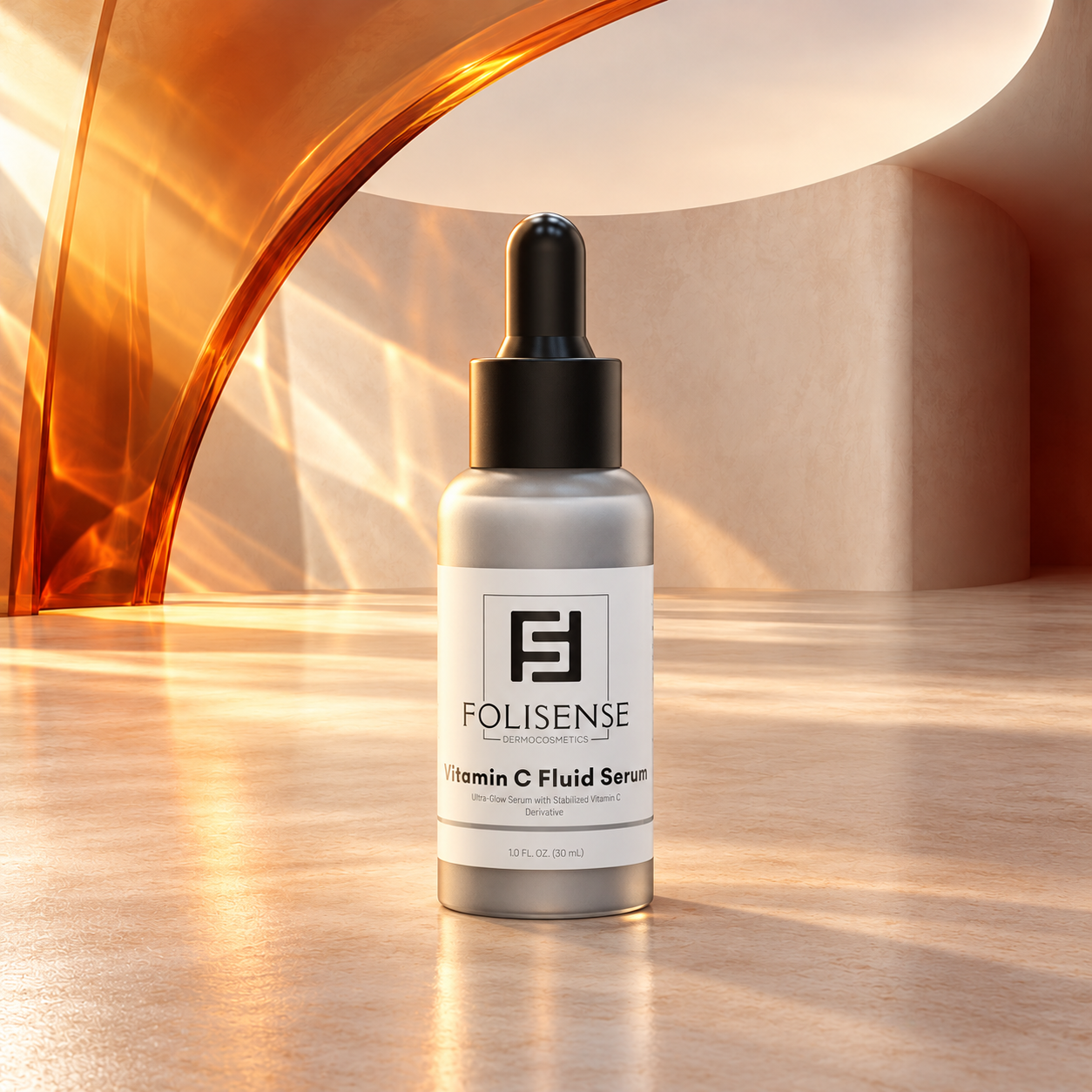
Folisense Vitamin C serum lists Sodium Ascorbyl Phosphate alongside Hexylresorcinol. Its directions place moisturizer and sunscreen after the serum, keeping the care steps distinct.
Directions for this serum
Apply 3–4 drops in the morning after cleansing and toner, before moisturizer and sunscreen.
Before use
Perform a patch test first. Mild stinging may occur. Keep away from light.
You applied the serum in the morning and will spend time outdoors. Which interpretation best places it in your care routine?
Answer and explanation
Correct; this serum’s own directions also place sunscreen after it.
Part 4 / 4
Keep exploring
Explore each product’s role alongside other care steps. Products in one line do not necessarily share directions; follow the individual product’s instructions.
Niacinamide is a form of vitamin B3. Skincare research has examined its role in barrier function and aspects of skin appearance. The barrier helps limit water loss, so surface oil and hydration are distinct but related concerns.
If skin looks shiny but feels tight after washing, reducing oil alone is not a complete care objective. Comfort, product tolerability and moisturization also matter. A line name does not decide the whole routine.
Explore the mechanism
Separate surface oil from skin hydration
Select a part to connect the diagram with the lesson.
Skin surface and outer layers
The overview provides orientation; the detail does not show scale or product penetration depth.
Surface oil
Oil at the surfaceWater in the stratum corneum
Water and skin comfort
Oil at the surfaceWater in the stratum corneum
Simplified teaching diagram, not to scale or a measure of effect. It does not simulate a product result.
Surface oil
Surface oil
A shiny surface alone does not establish adequate hydration. Observation timing and time since washing affect what you see.
Water and skin comfort
Water and skin comfort
If skin looks shiny but feels tight after washing, reducing oil is not the only care objective. Consider tolerability and moisturization too.
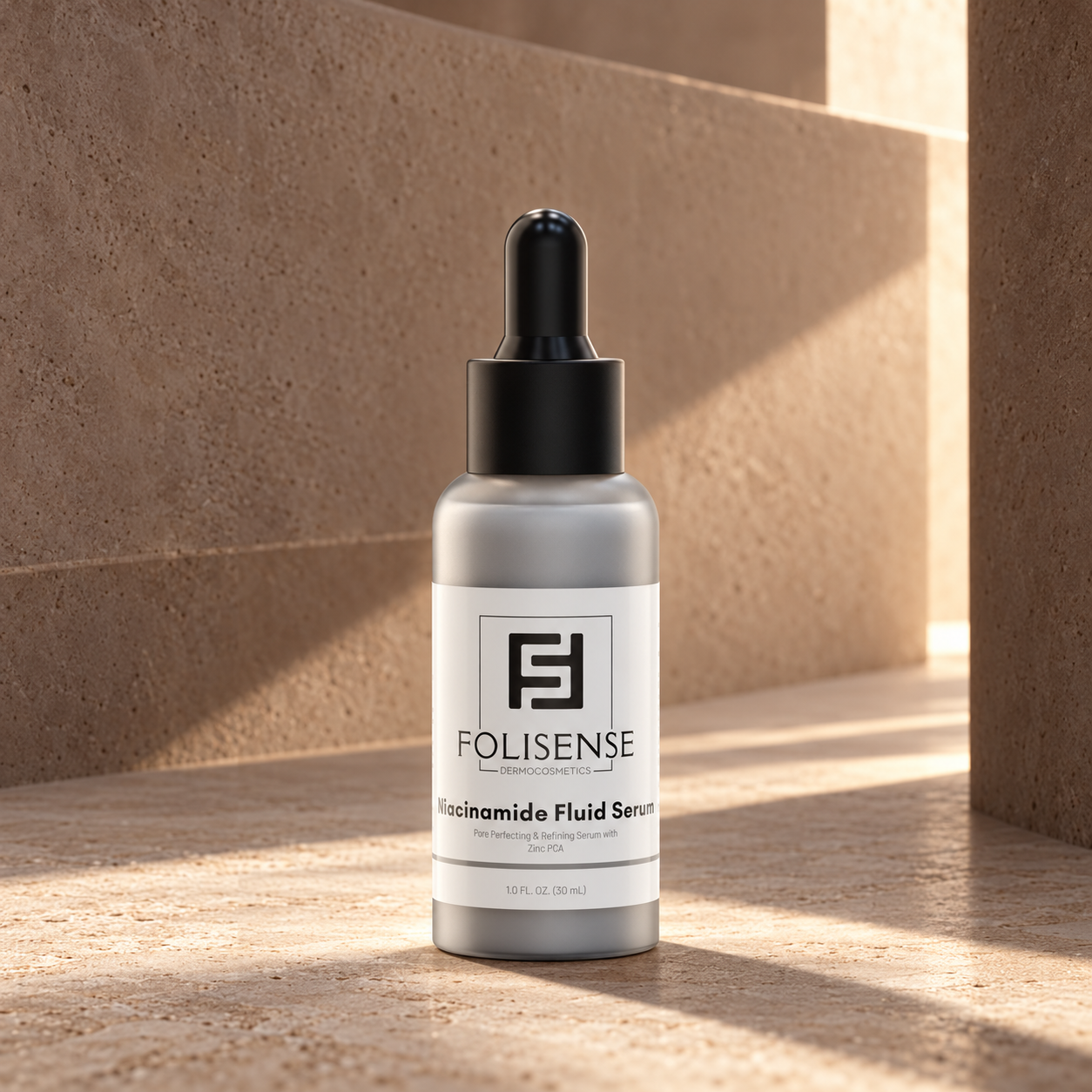
Folisense Niacinamide serum lists Niacinamide with Zn-PCA and Allantoin. Its directions place it after toner and before moisturizer. Choosing this line does not automatically remove the moisturizing step.
Directions for this serum
Apply a few drops to cleansed face and neck morning and evening, after toner and before moisturizer.
Before use
For external use only. Avoid eye contact; rinse thoroughly with water if contact occurs. Stop use if irritation or redness develops. Keep out of reach of children. Store below 30°C in a cool, dry place away from direct sunlight.
Someone with shiny skin wants to stop moisturizer when starting niacinamide serum, despite tightness after washing. Which response is more appropriate?
Answer and explanation
This keeps surface oil distinct from skin water. The Folisense serum directions also retain moisturizer.
Part 4 / 4
Keep exploring
Explore each product’s role alongside other care steps. Products in one line do not necessarily share directions; follow the individual product’s instructions.
Keeping skin moisturized involves both holding water and limiting its loss. Hyaluronic acid can bind water. Humectants, occlusive ingredients and emollients can contribute different roles in moisturizing care.
Immediate softness and lasting comfort through the day are not the same experience. When reviewing a routine, ask when skin feels comfortable and when dryness or tightness returns, rather than judging only the first touch after application.
Explore the mechanism
Holding water and limiting its loss
Select a part to connect the diagram with the lesson.
Complementary care roles
The overview provides orientation; the detail does not show scale or product penetration depth.
Attracting and holding water
Water holding: conceptual viewWater
Limiting water loss
Occlusive surface layerDirection of water loss
Simplified teaching diagram, not to scale or a measure of effect. It does not simulate a product result.
Attracting and holding water
Attracting and holding water
Hyaluronic acid can bind water. This illustration shows the water-holding role, not an exact molecular structure or a serum’s penetration depth.
Limiting water loss
Limiting water loss
Moisturizing care involves more than attracting water. Humectants, occlusives and emollients have different roles that may overlap within a formula.
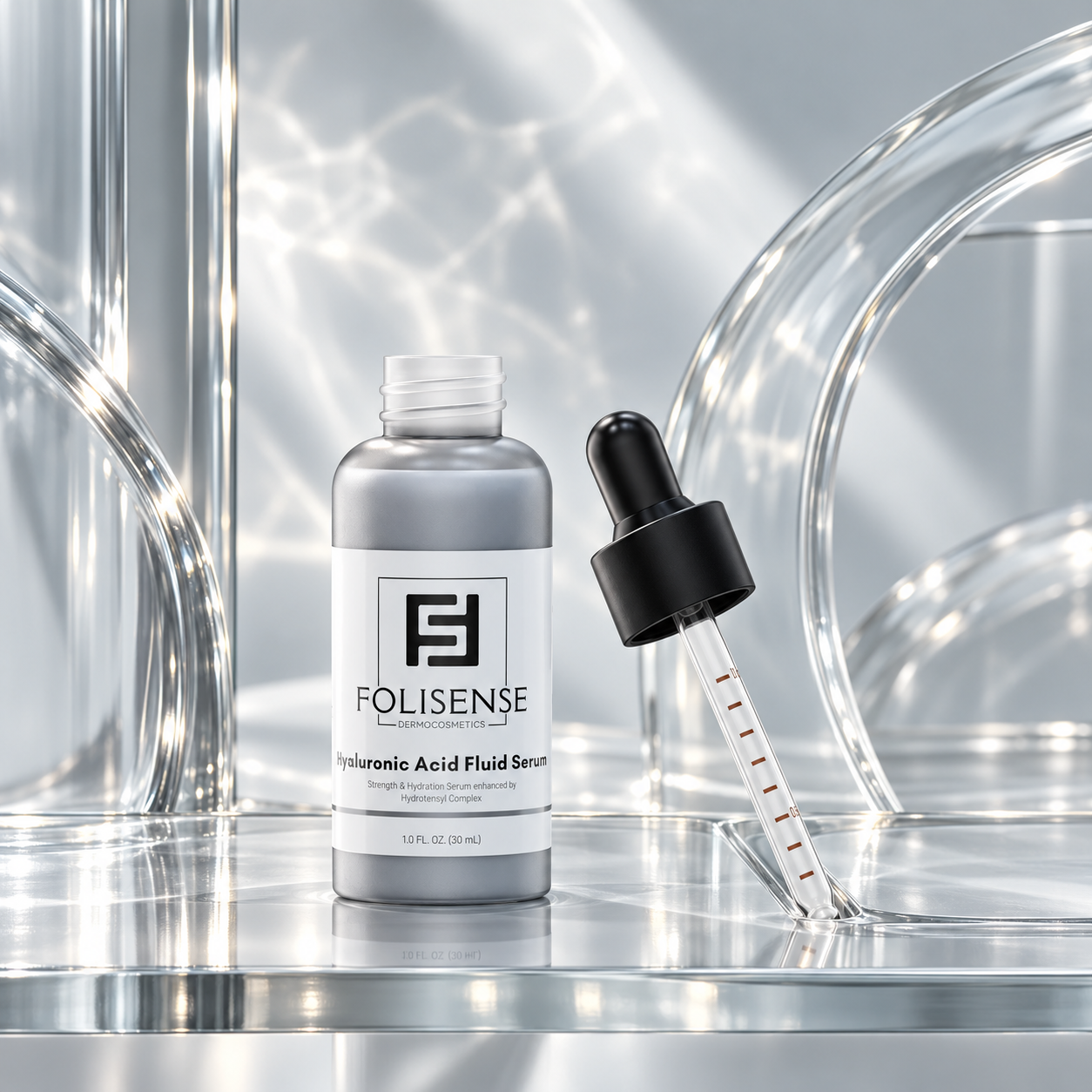
Folisense Hyaluronic Acid serum lists Hyaluronic Acid, Sodium Hyaluronate and Sodium PCA. Its directions place it before moisturizer. This positions the hydrating step alongside moisturizing care without prescribing one fixed combination for everyone.
Directions for this serum
Apply a few drops to clean skin morning and evening, after toner and before moisturizer. The master also describes layering beneath other serums.
Before use
For external use only. Avoid eye contact; rinse thoroughly with water if contact occurs. Stop use if irritation or redness develops. Keep out of reach of children. Store below 30°C in a cool, dry place away from direct sunlight.
Skin feels softer immediately after serum, but tightness returns later. Which question is more useful when reviewing care?
Answer and explanation
This follows the skin’s experience over time and across the routine, rather than a single immediate sensation.
Part 4 / 4
Keep exploring
Explore each product’s role alongside other care steps. Products in one line do not necessarily share directions; follow the individual product’s instructions.
This lesson develops three skills: distinguish vitamin C’s antioxidant role from its role in collagen biology, identify its formulation form, and choose a relevant outcome when following a routine. The professional question is more precise than whether vitamin C is useful: useful for which goal, in which product, and judged by which response?
Fictional consultation: someone asks about lingering facial discoloration and fine lines. First clarify which change matters most, then review its onset, sun protection, current products and tolerability. “Discoloration” is not a diagnosis, and one photograph cannot establish colour, texture and their causes at once.
Ascorbate participates in redox reactions through its reducing properties. Reactive oxygen species (ROS) contribute to ultraviolet injury. Acting on these reactions is a different mechanism from reducing ultraviolet transmission with sunscreen filters.
In cultured human fibroblasts, ascorbic acid supports proline hydroxylation and proper procollagen triple-helix formation. That biological role is not an observed reduction in facial lines: cellular response, tissue delivery and visible change are different levels of assessment.
Explore the mechanism
Trace two roles of ascorbate
Select a part to connect the diagram with the lesson.
From tissue to cellular function
The overview provides orientation; the detail does not show scale or product penetration depth.
Simplified teaching diagram, not to scale or a measure of effect. It does not simulate a product result.
Antioxidant role
Reducing activity is not UV filtering
This path shows a functional relationship: ascorbate participates in redox reactions through its reducing properties. Its role in ROS-related reactions differs from limiting UV transmission with a sunscreen filter. The arrows are neither chemical equations nor an SPF value.
Role in procollagen
Supporting a biological step, not becoming collagen
In the studied human fibroblast model, ascorbic acid supports proline hydroxylation and proper procollagen helix formation. Ascorbate does not become collagen. This cellular relationship does not establish a serum’s visible wrinkle reduction.
L-Ascorbic Acid and Sodium Ascorbyl Phosphate are not the same chemical form; the latter is abbreviated SAP. Assessment considers stability in the vehicle, packaging and storage alongside skin delivery. An ascorbic-acid preparation’s result cannot be transferred to every derivative simply because both carry the vitamin C name.
Worked example: to answer how to store this serum, read this product’s directions. A study of another emulgel does not create a refrigeration instruction or a new shelf life. Tingling is not a penetration test or antioxidant assay either. This distinction keeps care advice from becoming a guess about the formula.
Observation and interpretation
From ingredient identity to formula performance
Select a part to connect the diagram with the lesson.
Observe precisely, interpret separately
Schematic views: no scale, penetration depth or treatment outcome.
What does the exact ingredient name tell us?
L-Ascorbic Acid · L-AASodium Ascorbyl Phosphate · SAP
What happens inside the packaging?
Formula and packaging: conceptual view
Remaining in a formula is not the same as acting in skin
Skin surfaceDelivery and outcome need separate assessment
Simplified teaching diagram, not to scale or a measure of effect. It does not simulate a product result.
Chemical form
What does the exact ingredient name tell us?
L-ascorbic acid and sodium ascorbyl phosphate are distinct chemical forms. The Folisense serum master lists SAP. When reading a study, first match the ingredient form; the umbrella name “vitamin C” does not establish equivalent formula behaviour.
Formula stability
What happens inside the packaging?
Stability concerns the complete formula, packaging and storage conditions. Data from a research emulgel is not a storage instruction for another serum. Follow the specific product’s directions; this illustration gives no temperature, shelf life or stability ranking.
Delivery and outcome
Remaining in a formula is not the same as acting in skin
Presence in a formula, stability, skin delivery and a visible outcome are separate questions. Tingling is not a penetration test or an antioxidant assay. Interpret an outcome by recording the endpoint and assessment conditions separately from the ingredient name.
Folisense Vitamin C serum lists Sodium Ascorbyl Phosphate with Hexylresorcinol. Its directions place it in the morning after cleansing and toner, before moisturizer and sunscreen. Explain its role in that sequence; the presence of two ingredients does not establish clinical synergy or a fixed time to a colour change.
For follow-up, define the goal at the outset: uneven colour appearance, fine lines or routine tolerability. Comparable photographs and a consistent use history support discussion, but an observed change alone does not prove its cause. Record other steps changed at the same time.
Directions for this serum
Apply 3–4 drops in the morning after cleansing and toner, before moisturizer and sunscreen.
Before use
Perform a patch test first. Mild stinging may occur. Keep away from light.
Fictional case: after starting serum, a person reports a brighter complexion. The earlier photo was taken by a window and the new one under warm light; sunscreen use also became more consistent. They ask you to confirm the serum’s effect.
Which response best supports follow-up?
Answer and explanation
The person’s report is worth following, but is distinct from measurement and causal attribution. This keeps the colour objective and improves the next comparison.
Part 6 / 7
Case 2: burning in a new routine
Fictional case: someone introduced a serum and a new exfoliating product in the same week. Persistent burning and redness develop. They ask whether this means vitamin C is working. Distinguish this presentation from a brief, transient sensation that a product description may mention.
What is your first priority?
Answer and explanation
Address the skin reaction first. Onset, affected sites and all products inform assessment; this short history does not establish allergy or a responsible ingredient.
Part 7 / 7
Putting the reasoning into practice
Keep three points clear in consultation: a followable goal, the product’s place in the routine and skin tolerability. Distinguish antioxidant activity from UV filtering, collagen biology from visible results, and application sensation from efficacy. Review the exact product’s directions and choose a specific outcome for the next conversation.
Applied practice · Professional path
Following colour change and fine lines
This is a fictional learning scenario, not a patient report or study result.
Practice answers stay in this browser session; lesson progress is separate.
Decision 1 / 3
A person has chosen Folisense vitamin C serum for “more even colour and less visible lines”. They ask what to assess at follow-up.
Which starting definition is more precise?
Read the suggested reasoning
Record colour, line appearance and tolerability separately under comparable conditions
Three distinct outcomes are specified. This helps identify what changed without jumping from appearance to a cellular mechanism.
Use less visible lines as a direct measure of collagen synthesis
Line appearance has several influences. A visible change is not a direct measurement of collagen synthesis.
Combine colour and lines into one overall impression of rejuvenation
That impression may describe the person’s experience, but does not identify changes in colour, lines or tolerability.
Decision 2 / 3
At follow-up, lines look less visible in a new photograph. The first was taken before daily care beside a window; the new one follows moisturiser application under different lighting.
Which action makes the observation more interpretable?
Read the suggested reasoning
Enlarge the photographs and count lines without standardising conditions
Precise counting does not remove differences in lighting or surface condition. Clarify comparison conditions first.
Ask about satisfaction and substitute it for the photographs
Satisfaction matters to the person’s experience, but is a different outcome from line appearance and should be recorded separately.
Repeat documentation with comparable lighting and care timing, alongside the person’s report
This creates a more interpretable comparison. Even matched photographs alone do not establish a mechanism or the serum’s specific contribution.
Decision 3 / 3
The person reports more regular moisturiser and sunscreen use during the same period, then asks: “So the serum has made collagen?”
Which response correctly relates observation and mechanism?
Read the suggested reasoning
Less visible lines confirm the collagen mechanism even if other care changed
Biological evidence for a mechanism does not replace measuring it in this person. Changes in other care also complicate attribution.
We can record appearance changes, but this follow-up cannot establish collagen synthesis or isolate the serum’s contribution
This respects the person’s experience while preserving the inference boundary. Antioxidant roles or collagen biology do not automatically establish this formula’s outcome in this person.
Because several factors changed, no observation is worth recording
Observation still helps follow the goal and tolerability. Limited causal attribution does not make follow-up worthless.
Case debrief
We separated the observable goal from the mechanism, assessed photographs against comparison conditions, and avoided inferring collagen synthesis. Consistent follow-up can clarify appearance and tolerability, but does not by itself isolate one product’s contribution.
This exercise supports reasoning practice; it awards no competence rating or professional certificate.
This lesson distinguishes investigated niacinamide roles in barrier lipids, pigment transfer and surface oil, then applies those distinctions in consultation. An oily appearance, dryness and lingering marks can coexist. They should not all be judged by one response measure.
Fictional consultation: a person reports a shiny forehead by midday, tight cheeks after washing and visible marks from earlier blemishes. Clarify the time and site of each concern, new lesions and recent routine changes. Three sentences do not establish a diagnosis; they help select questions and a follow-up approach.
In human keratinocyte research, nicotinamide was associated with increased ceramide synthesis and activity of serine palmitoyltransferase, an enzyme in sphingolipid synthesis. This concerns cellular lipid production, not direct addition of ceramides to a product.
In this history, a less shiny forehead does not answer whether cheek tightness improved. Follow tightness timing and washing tolerability separately from oil appearance. If instruments are used, specify whether they assess water content, water loss or surface oil; these observations are not interchangeable.
Observation and interpretation
From a living keratinocyte to the lipid space
Select a part to connect the diagram with the lesson.
Observe precisely, interpret separately
Schematic views: no scale, penetration depth or treatment outcome.
Which process did the cellular research examine?
NucleusLiving keratinocyte
SPT activity in sphingolipid synthesis
Ceramide synthesis in a cell model
Cell research does not establish finished-product efficacy.
Synthesis and barrier organisation are different views
Anucleate corneocytesIntercellular lipids
Which observation still needs an answer?
Sebum at the surfaceStratum-corneum water
Simplified teaching diagram, not to scale or a measure of effect. It does not simulate a product result.
Living cell
Which process did the cellular research examine?
In cultured human keratinocytes, nicotinamide was associated with increased ceramide synthesis and serine palmitoyltransferase (SPT) activity. SPT participates in sphingolipid synthesis. This view does not locate the enzyme or show reaction speed; it highlights lipid synthesis by a living cell.
Between corneocytes
Synthesis and barrier organisation are different views
The stratum-corneum view shows anucleate corneocytes beside intercellular lipid space. Ceramides are part of this system alongside cholesterol and free fatty acids. Lines simplify lamellar organisation; selecting this view does not simulate skin repair or a lipid increase after use.
Interpretation in care
Which observation still needs an answer?
Increased lipid synthesis in a research model is not the same as adding ceramides to a product, and does not establish repair efficacy for a Folisense formula. A less shiny forehead and tight cheeks after washing need separate assessment; forehead appearance does not answer the question about cheek hydration or tolerability.
Melanosome transfer differs from melanin synthesis
Melanosomes are pigment-carrying organelles. In melanocyte–keratinocyte coculture research, niacinamide reduced melanosome transfer; direct tyrosinase inhibition was not observed in the assay studied. Pigment transfer and pigment synthesis are therefore distinct mechanistic explanations.
Worked example: when someone says “acne marks,” clarify whether they mean flat colour changes, depressions or raised areas, or lesions that remain active. A pigment-transfer mechanism does not promise to resolve all of these. New breakouts also matter; focusing only on old marks can overlook an active problem.
Explore the mechanism
Pigment production, transfer and receipt
Select a part to connect the diagram with the lesson.
Location in the epidermis
The marked region locates the close-up; the two views are not to the same scale.
A closer look at the cell interface
MelanocyteKeratinocyte
Pigment-bearing melanosomes
Cell-contact region
Keratinocyte nucleus
This view shows the relationship between cells, not a definitive route across their membranes.
Simplified teaching diagram, not to scale or a measure of effect. It does not simulate a product result.
1 · Melanocyte
Pigment production in the source cell
In the close-up, the green cell is the melanocyte; dark marks within it represent pigment-bearing melanosomes. Melanin production and transfer of these organelles are distinct steps. Dot counts are illustrative, not quantitative.
2 · Melanosome transfer
This connection was a focus of niacinamide research
The outlined region highlights the melanocyte–keratinocyte interface in close-up. Coculture research reported reduced transfer with niacinamide; the diagram shows neither complete blockade nor a product’s effect size. Detailed transfer routes are simplified here.
3 · Keratinocyte
Distinguish receiving pigment from producing it
The pale cell in the close-up is the receiving keratinocyte. Direct tyrosinase inhibition was not observed in the same study’s assay; melanosome transfer should not be rephrased as switching off melanin synthesis. A cell-model result is not a promise to remove all marks or scars.
Sebum present on the surface at a given time is not the same quantity as sebum excretion rate. Clinical niacinamide research measured these separately, with differing responses across groups. Less visible shine does not directly establish an equivalent reduction in secretion.
For a practical comparison, record time of observation, time since washing, and sunscreen, makeup or blotting products. This does not turn everyday observation into a laboratory assay; it clarifies what was compared. Follow comfort and new lesions separately rather than summarising everything as shine.
Observation and interpretation
Three questions about skin oil
Select a part to connect the diagram with the lesson.
Observe precisely, interpret separately
Schematic views: no scale, penetration depth or treatment outcome.
How much oil is on the surface now?
Sebum at the surfaceAmount at the observation time
What does measurement over time ask?
Sebum at the surfaceTime interval; no invented reading
What can appearance not establish?
Sebum at the surfaceIncident and reflected light: conceptual
Simplified teaching diagram, not to scale or a measure of effect. It does not simulate a product result.
Surface amount
How much oil is on the surface now?
Surface sebum amount is an observation at a particular time and under particular conditions. Washing, blotting and products on the skin matter to its interpretation. A lower amount alone does not show that glands have excreted less sebum per unit time.
Sebum excretion rate
What does measurement over time ask?
Sebum excretion rate concerns sebum output over a defined interval using a specified method; it is not obtained from one photograph or a casual surface measurement. Niacinamide research measured surface level and excretion rate separately, with different response patterns. They are not interchangeable.
Visible shine
What can appearance not establish?
Shine is the appearance of a surface under particular lighting, not a direct measurement of gland activity. Record lighting, timing, last wash and sunscreen or makeup use for follow-up. Switching this illustration keeps the oil amount constant; no reduced secretion or treatment outcome is simulated.
Folisense Niacinamide serum lists Niacinamide, Zn-PCA and Allantoin. Its directions specify a few drops on clean face and neck morning and evening, after toner and before moisturizer. For someone with both shine and tightness, this sequence does not imply automatically removing moisturizer.
At follow-up, identify the exact product, actual use and simultaneous changes. This serum’s warning says to stop use if irritation or redness occurs. Tolerability belongs in the care decision; reduced apparent oiliness does not justify ignoring a reaction. Multiple ingredients alone do not establish synergy or acne treatment.
Directions for this serum
Apply a few drops to cleansed face and neck morning and evening, after toner and before moisturizer.
Before use
For external use only. Avoid eye contact; rinse thoroughly with water if contact occurs. Stop use if irritation or redness develops. Keep out of reach of children. Store below 30°C in a cool, dry place away from direct sunlight.
Fictional case: after starting serum, someone also changed cleanser and washes more often. The midday photo looks less shiny, but the cheeks are red and burning. They call this successful oil control and want to remove moisturizer.
Which decision takes priority?
Answer and explanation
This keeps two outcomes distinct and follows the product warning. Several simultaneous changes prevent a firm causal conclusion; assess reaction and tolerability first.
Part 7 / 8
Case 2: old marks and new breakouts
Fictional case: someone uses a cosmetic routine for flat brown marks after blemishes but still develops new painful breakouts. They ask why all “acne marks” have not faded and whether niacinamide should resolve both concerns. Disease diagnosis and treatment require clinical assessment; this exercise asks how to direct discussion and follow-up.
Which response follows the person’s concerns more fully?
Answer and explanation
This recognises the current priority without losing the colour objective. A cosmetic serum should not create an expectation of treating painful lesions or every kind of mark.
Part 8 / 8
One follow-up, distinct outcomes
Close the consultation by specifying what will be reviewed: shine under comparable conditions, tightness and tolerability, old-mark appearance or new lesions. Record the information relevant to each. This clarifies niacinamide’s roles without presenting one product as the answer to every skin concern.
Applied practice · Professional path
Following surface oil and tightness
This is a fictional learning scenario, not a patient report or study result.
Practice answers stay in this browser session; lesson progress is separate.
Decision 1 / 3
After starting niacinamide serum, a person sees less forehead shine. They used blotting paper just before the follow-up photograph but not before the baseline photograph.
Which conclusion is most defensible now?
Read the suggested reasoning
The gland produced less sebum because the photograph is less shiny
A photograph does not measure gland activity. Removing surface oil is not the same as changing sebum excretion rate.
Blotting altered surface conditions, limiting direct comparison
Align recording conditions before attributing change to the serum. The present observation can still be documented with the blotting noted.
Similar lighting means blotting has no relevance
Lighting is only one condition. Removing surface oil can change appearance even under the same light.
Decision 2 / 3
Further history reveals cheek tightness after washing. The person asks whether reduced forehead shine also indicates a better cheek barrier.
Which follow-up approach is more appropriate?
Read the suggested reasoning
Record site and timing of tightness, cleansing and tolerability separately from shine
This investigates the cheek concern independently. If measurement is needed, stratum-corneum water and water loss are also distinct questions.
Infer barrier improvement from forehead appearance
Neither the site nor the outcome is the same. Lipid-synthesis research cannot turn this observation into proof of barrier repair.
Average shine and tightness into one overall score
A combined score may hide worsening in one outcome beneath improvement in another. Track each separately first.
Decision 3 / 3
The person then points out flat brown marks from previous blemishes and several new painful lesions. They ask whether the melanosome-transfer explanation covers both.
Which summary best guides further assessment?
Read the suggested reasoning
Follow both in one skin-colour photograph; lesion type is unnecessary
Colour alone does not preserve the distinction between a residual flat mark and an active lesion. Form, onset and symptoms matter.
Because niacinamide relates to pigment transfer, painful lesions share the same endpoint
Pigment-transfer biology does not determine diagnosis or treatment of an active lesion, or establish acne-treatment efficacy for this formula.
Separate pigment appearance from active lesions; painful lesions need appropriate clinical assessment
This lets each concern be followed with the right question. A mechanism explanation does not replace lesion diagnosis or treatment decisions.
Case debrief
We did not treat surface oil, sebum excretion rate, tightness and mark appearance as one outcome. Each needs its own observation and conditions. Niacinamide mechanisms help frame better questions; they do not replace measurement or necessary clinical assessment.
This exercise supports reasoning practice; it awards no competence rating or professional certificate.
In a fictional case, a person with shiny skin reports tightness after washing. Distinguish surface sebum from water in the stratum corneum. An oily appearance alone does not establish hydration or cleanser tolerability; symptom timing and routine changes matter.
Within corneocytes, natural moisturizing factor (NMF) contributes to water-holding capacity; filaggrin breakdown products form part of it. Between cells, the lamellar lipid matrix limits water transport. Water content and the rate of loss are therefore related dimensions, not interchangeable terms.
Explore the mechanism
Stratum-corneum water and outward flux
Select a part to connect the diagram with the lesson.
Skin surface and outer layers
The overview provides orientation; the detail does not show scale or product penetration depth.
1 · Water holding
NMF within a corneocyteWater
2 · Lipid matrix
CorneocyteIntercellular lipid space
3 · Water flux and TEWL
CorneocyteDirection of water loss
Simplified teaching diagram, not to scale or a measure of effect. It does not simulate a product result.
1 · Water holding
Inside the corneocyte
Blocks represent corneocytes. Natural moisturising factors (NMF) within them contribute to water holding. Highlighting this region locates the role; it does not indicate water quantity or a hydration increase.
2 · Lipid matrix
Between corneocytes
Spaces between blocks represent the lamellar lipid matrix that helps limit water passage. This organisation differs from an occlusive surface layer, and the barrier is not an impermeable wall.
3 · Water flux and TEWL
Outward flux differs from water content
The outward arrow conceptually represents transepidermal water loss (TEWL), not an exact molecular route or speed. This differs from stratum-corneum water content; selecting it does not imply a hydration increase or decrease.
Humectants support water attraction and retention. Occlusives form a hydrophobic layer that limits evaporative loss. Emollients improve softness and smoothness. These are functional categories; roles can overlap within an ingredient or formula.
A surface occlusive layer is not the same as rebuilding the skin’s own lipid organisation. Record a report of improved softness, but do not infer sustained hydration or structural barrier restoration from that report alone.
Part 3 / 5
Interpreting hydration and TEWL
Electrical methods such as capacitance measurements use water-dependent properties to assess stratum-corneum hydration. Transepidermal water loss (TEWL) concerns water leaving through the epidermis. TEWL instruments estimate outward flux, not the amount of water held in the stratum corneum.
When following a response, anatomical site, temperature, humidity, acclimatisation, recent washing and product timing need to be comparable. Reported comfort is a separate observation. The clinical question determines how each observation is interpreted alongside the others.
Interpreting observations
Which question does each observation answer?
Select a part to connect the diagram with the lesson.
One tissue, three kinds of observation
Switching sections changes the observation, not the skin’s state in this illustration.
How is superficial hydration assessed?
Stratum-corneum waterMeasurement symbol; no reading or device model
What do we know about outward water loss?
Water moving outwardMeasurement symbol; no reading or device model
What sensation, when, and after which care step?
The person’s reported experienceA person’s report, not a device reading
For comparison, account for measurement site, environment, acclimatisation, washing and product timing.
Simplified teaching diagram, not to scale or a measure of effect. It does not simulate a product result.
Water content
A water-dependent electrical response
Capacitance measurements use water-dependent electrical properties to assess stratum-corneum hydration. Interpret the result within the method and measurement conditions; it does not establish outward water flux or restored lipid organisation.
Water loss
Outward water flux through the epidermis
TEWL concerns outward water flux. It differs from water content in the stratum corneum. If TEWL shows no clear change at follow-up, that observation alone does not rule out a hydration change.
Reported comfort
Read the person’s experience in its timing and context
Softness or tightness is the person’s account of how their skin feels. Establish its timing relative to washing and product use. It matters in follow-up, but is not itself a water-content or TEWL measurement and does not establish persistence.
In a fictional teaching example, repeated measurements under comparable conditions show increased stratum-corneum capacitance, with no clear TEWL change. The person also reports softer skin. Which interpretation best fits these observations?
Answer and explanation
Capacitance and TEWL concern different quantities. Subject to method limitations, the first is consistent with a hydration change; softness is a separate sensory report. Persistence needs follow-up over time.
Part 4 / 5
Applying this to Folisense care
Folisense Hyaluronic Acid serum lists Hyaluronic Acid, Sodium Hyaluronate and Sodium PCA. Its directions place it before moisturizer. This helps explain the care steps, but ingredient names do not supply a formula-specific TEWL measurement or barrier-restoration result.
In the fictional case, the person changed cleanser and serum together. Serum feels softening, but burning returns after washing. Which step gives more useful information about the symptoms and routine?
Answer and explanation
Two simultaneous changes make causal attribution difficult. A step-by-step history distinguishes softness, irritation and timing; this example alone establishes neither a diagnosis nor a decision to continue use.
Part 5 / 5
Keep exploring
Explore each product’s role alongside other care steps. Products in one line do not necessarily share directions; follow the individual product’s instructions.
Applied practice · Professional path
Following hydration, softness and water loss
This is a fictional learning scenario, not a patient report or study result.
Practice answers stay in this browser session; lesson progress is separate.
Decision 1 / 3
A person uses hyaluronic acid serum before moisturiser and says: “My skin feels softer immediately, so it must be retaining more water.” You want to document their experience precisely.
Which record separates observation from inference?
Read the suggested reasoning
Immediate softness confirms a sustained increase in stratum-corneum water
A better surface feel can reflect emollient effects. A brief report of softness does not establish water content or persistence.
Softness is reported; water content and persistence have not been assessed separately
This preserves the person’s experience without turning it into a measurement result. Softness, stratum-corneum water and duration are different questions.
Because the sensation is subjective, it should not be recorded
The report matters to care experience and tolerability. Record it separately from an instrumental measurement.
Decision 2 / 3
In a fictional follow-up, an electrical hydration measurement is higher. The first recording was before care; the second followed moisturiser use in a different-humidity environment. No numerical values or diagnostic thresholds are supplied.
Which action best precedes a conclusion about lasting change?
Read the suggested reasoning
Align site, environment, acclimatisation and washing/product timing for the next comparison
These factors matter to interpretation. Specify the measurement method and conditions; this exercise prescribes no waiting time or numerical protocol.
Substitute TEWL for hydration measurement without correcting comparison conditions
TEWL assesses outward water loss, not the same water-dependent electrical property. Changing instruments alone does not solve mismatched conditions.
Accept the difference as lasting because both readings came from an instrument
Instrumental readings are not independent of conditions. This comparison has not established duration or each care step’s contribution.
Decision 3 / 3
The person now asks: “If an occlusive layer limits water loss, does that mean the barrier’s lipid organisation has been rebuilt?” Your aim is to distinguish a surface function from structural reconstruction.
Which response is more precise?
Read the suggested reasoning
Limited water loss alone demonstrates rebuilt lipid organisation
A water-loss outcome and a structural reconstruction claim are not equivalent. A surface effect alone is insufficient for the structural inference.
An occlusive layer only changes surface feel and has no relationship to water loss
This confuses occlusion with softness alone. Limiting evaporative loss is the function being discussed.
A surface layer can limit water loss; that function alone does not prove reconstruction of the skin’s own lipids
This preserves the function/structure distinction. Humectant, occlusive and emollient roles can also overlap within a formula.
Case debrief
We separated perceived softness from stratum-corneum water and outward water-loss rate. Humectant, occlusive and emollient roles help explain care but do not replace outcome assessment. Comparable conditions make observations more interpretable; one surface observation or measurement does not establish lasting barrier reconstruction.
This exercise supports reasoning practice; it awards no competence rating or professional certificate.